
Introduction
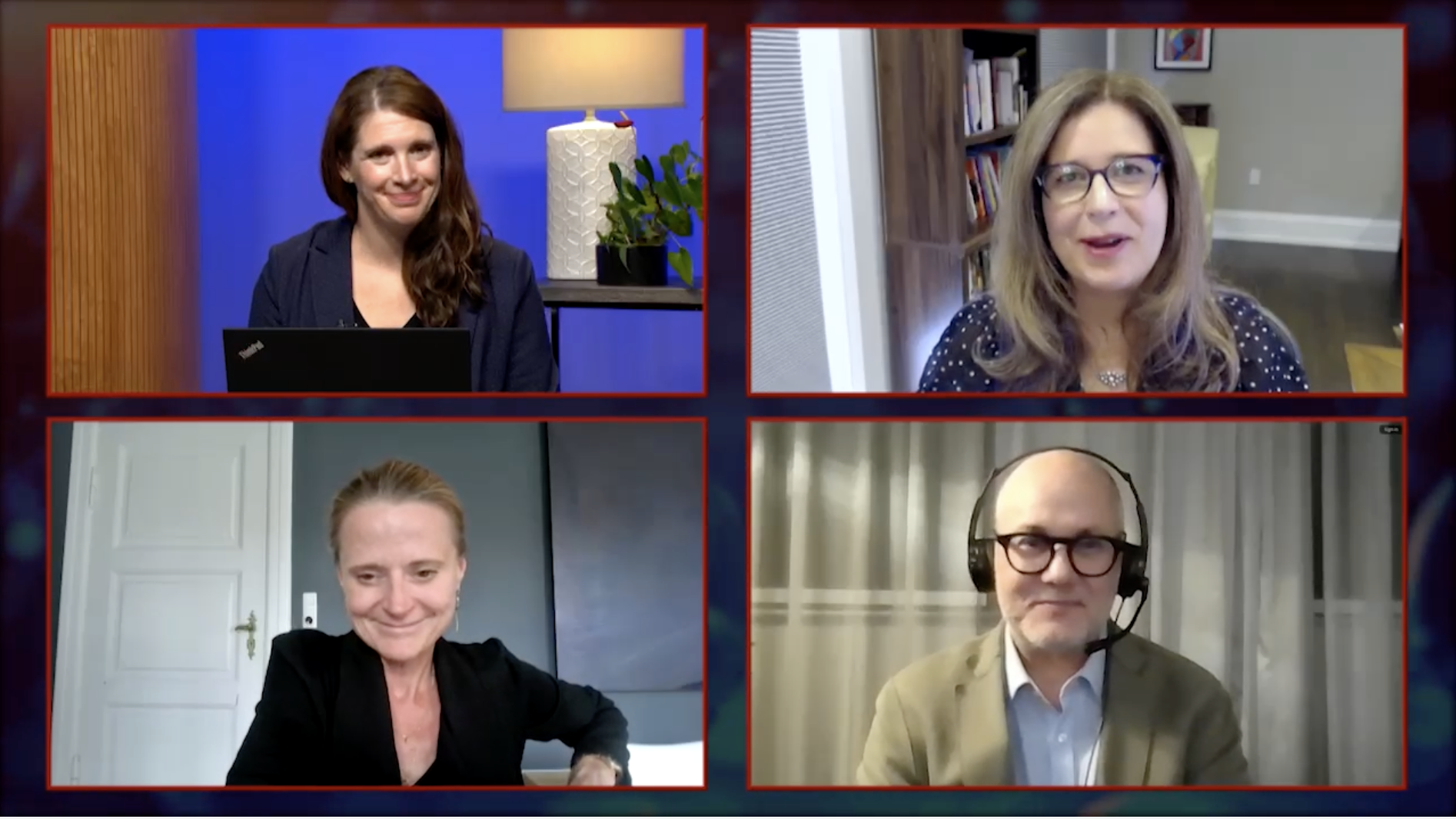
The panel was introduced by Erika Berg, Ph.D., who is Director and Senior Editor for custom publishing at Science and the moderator for this discussion.

Around the globe, the gender gap stubbornly persists in many aspects of life, from work compensation to healthcare. There are many reasons for this women’s health gap, including bias, stigma, and biology. Clinical trials have skewed male, while female-centric conditions like PMS and menopause are understudied. It’s also become increasingly clear that chronic conditions including cardiovascular and autoimmune diseases can affect women differently or disproportionately.
This panel of experts will explore the unique health challenges that women face and the crucial role of sex specific research in driving medical innovation. Sponsored by the Bio-Innovation Institute (BII). The speakers are:
Liisa Galea, Ph.D. is the Treliving Family Chair at The Centre for Addiction and Mental Health in Toronto Canada, as well as a professor of pyschiatry at the University of Toronto. She has been studying how sex and sex-related factors influence various brain disorders for about thirty years. She is the lead of the Women’s Health Research Cluster and the scientific lead of womenmind and camh, and advocate for women’s health research.
Henriette Nielsen, MD is a medical professional, chief physician of obstetrics and gynecology in Copenhagen and a professor at the University of Copenhagen. She is also a grantee of the Bio-Innovation Institute research grant, fulfilling the circle and she very much looks forward to being here today.
Aris Papageorghiou, MD is a professor obstetrics and fetal medicine at the University of Oxford, and he is also a clinician – he works clinically and still delivers babies at St George’s Hospital in London. His focus is on global maternal and perinatal health, through which he has a number of research programs. Today he will be examining data gaps in relationship to that area.
Aris Papageorghiou
Dr Papageorghiou shared a far-ranging perspective about the trends that are impacting women’s health and care delivery – you can see the big themes of his presentation in the screenshot below.

While women are 50% of the population, most health research that is not female-specific is still conducted with males. Animal experiments use male animals. The argument is that female physiology is “more complicated” because of cyclical hormonal changes (including menopause), and the use of different kinds of contraception.
There are also differences in how the liver and kidney works. This disadvantages women – they may be over-medicated because drugs were designed for male subjects. The weight might be adjusted, but not all these other parameters.
Because of that, there has been a focus on disaggregating data by sex. The World Health Organization (WHO) just started doing that in 2019. There are two types of data gaps:
- Women are at a higher risk of misdiagnosis
- Differences in focus and funding
In addition to these data gaps, and how might trends around the world affect innovation and treatment in women’s health? There are recent shifts and widening gaps:
Rapid urbanisation affects not just models of care in perinatal and maternal health, but also infectious disease. This doesn’t affect just low and middle income countries – the U.S. has maternity care deserts. There may only be one obstetrician in a rural area, which disadvantages those who live there. This is not a low income setting (by global standards) – this is in the USA.
Changing demographics may create new data gaps such as the age at first pregnancy, underlying conditions, etc. This is data from the EU:

In this dataset, women and men have a similar distribution. But burden of disease (in terms of outcomes) is heavier for women – they are much more likely to die, have another heart attack, or be disabled.

This is happens because classic symptoms have only been described for men. When data gaps exist, the gaps get filled with information that may not be accurate. These claims have been refuted scientifically, but the slow emergence of data causes rapid distribution of misinformation. These have been refuted scientifically, but the misinformation spreads rapidly. Dr. Neel Shah of the recently addressed this on LinkedIn. The Maven Clinic has observed that 57% of the videos related to #TTC or “trying to conceive” contain misinformation; the number jumps to 72% when the presenter is selling something. The median engagement on these videos is 14K likes. Maven has undertaken a program to combat that misinformation with peer-reviewed research. The full article is available on Maven Clinic’s The Preprint.
Papageorghiou went on to describe that climate change affects women disproportionately, including the effects of heat, and food and water insecurity.
And finally, technology. The BII has been working on a project on pregnancy imaging in underserved regions, because about 50% of women have no access to ultrasound during pregnancy. It is an important means of checking for twins, pregnancy viability, growth of the baby, the health of the placenta, etc. So they are teaching computers how to read ultrasound scans in order to make imaging more accessible. This enables healthcare workers – who might not be professionally trained – to conduct such exams.

Like a self-driving car identifying a pedestrian, a car, or a truck, each of the parts is identified – placenta, fetal parts, etc. Their solution now provides provides basic imaging in parts of the world where more sophisticated infrastructure doesn’t exist.
We have research in all these areas that he didn’t have time to review in detail, but BII research and thinking is guided by some of these trends around the world.
Henriette Nielsen
The focus of Dr Nielsen’s presentation was the opportunities and responsibilities in women’s health research.
As a young doctor she became deeply interested in understanding pregnancy loss. It happens in 1/4 pregnancies but she could not answer patient questions about why it happened and how to avoid it happening again. However, she was rejected for 31 grants to do a Ph.D. on this topic.
Instead, she followed in her grandfather’s footsteps and worked in obstetrics ward in Western Ethiopia. There, she witnessed the dangers of being pregnant in low-resourced settings. What surprised and shocked her the most was lack of skills among the staff to handle life-threatening complications. That is why she created the Maternity Foundation – the aim was that it shouldn’t cost life to give life. They took advantage of mobile phone revolution in Africa, where most people have access to phones than to basic sanitation.

And then they compressed global guidelines into short educational videos and quizzes – gamified learnings.
In a cluster randomized trial for one year, having this app in hands of healthcare workers “significantly and highly increased” ability to handle life-threatening emergencies, and health outcomes remained the same in facilities without the app. More than 430K healthcare workers have used it since launch almost ten years ago, and it has made pregnancy and childbirth measurably safer. It’s freely available, it works offline once downloaded.
Back in Copenhagen, she was finally granted funds to do her research. Those four years really opened her eyes to why and how poorly we define issues related to women’s health and reproduction – her research raised many more questions than answers.
Back 2011 she started dreaming about making a huge step in understanding why one in four pregnancies are lost. That was the motivation behind starting the Copenhagen Pregnancy Loss Cohort (COPL). Below is the timeline – she encourages those of us in research to keep going! They wrapped up grant applications in 2013, but it took until 2017 to get funded.

She has learned so much – mostly that they were very early in the space. At the time, pregnancy loss was not considered scientific. It was deemed “not interesting” because we know something is wrong with the fetus and it’s nature’s “quality control”.
In 2017 they finally got money to get them started, and they secured ethics approval in 2018. The program included DNA sequencing of father, mother, and fetus. They received a huge grant from BII in 2020, which gave them money to research 1500 trios, and then in 2023 they received funding for 3000. They have studied 2650 trios so far.
Here is an overview of samples and visits:

Now they have a new grant to closely follow 3K couples from the start of one pregnancy to the next. They have also linked the data they collect to the national registries in Denmark – which is a powerhouse.
She has shown what she believes are obligations of researchers and clinicians. What has taken so many years? They are collecting a multitude of different data points:

Now patients are involved – they are not just talking about it, but demanding answers and what they can do to avoid pregnancy loss.
Academic / research journals are now getting involved. In 2021 there was a Lancet miscarriage series – the editor said that the era of just telling couples to try again is over.

Nature Medicine had a theme issue in 2024 throughout the life course. However, she sees that studies are still not getting funded – huge funding and knowledge gaps remain. Women’s Health can look immature relative to other disease areas.
World Economic Forum and McKinsey made a clear ask to focus on women’s health at Davos. This would be beneficial not just for the women in poor health, but would also be good for the economy. The potential is huge for those daring to invest!

However, with increased interest from investors comes with challenges – a dilemma.

We see a focus on treatment, aesthetics, and wellness. But what remains lacking is deep understanding – we need to understand biology. We will have no treatments without an understanding of the biology. How can we accelerate getting knowledge?
Liisa Galea
Thanks for the opportunity to talk about her very favorite topic. As a neuroscientist she focuses on the biomedical aspects of sex and sex-related factors impacting brain disorders. Gender also plays a role because it is more than an identity – it is a psychosocial construct. Because society has expectations of our roles and conduct given our gender identity.

Though she focuses on sex and biomedical approaches to women’s health, the disparities she is going to discuss are manifold greater in people of color, indigenous, trans, and neurodiverse individuals. It is important to acknowledge and understand the experiences of these different communities as they will have a different influence on health and disease risk as compared to men and women.
Dr Galea believes we need a lifespan approach. There are numerous sex differences in the prevalence of brain disorders. In this graphic (below), blue appears earlier in life, pink later – suggesting that we need a lifespan approach to understand these disorders.

However, prevalence is one thing, something more interesting to her and perhaps more challenging is that there are manifestation differences as well, between males and females in a variety of disorders, not just brain disorders.
This makes is more complex to diagnose and treat if sex and gender are not considered. A large Danish study found that for over 980 different disorders, women are diagnosed 3.7 years later than males for the same disorder:

There are many reasons for this on the biological and social side of things, but one of the major reasons is because most of our medical research – including the way we diagnosis people – has been done solely based on research and experiences in men. So much so that symptoms in women are called “atypical”:

And you see this atypical label across a wide variety of disorders – those with a great male prevalence, those with a greater female prevalence, those with no sex difference in prevalence at all – suggesting that there is a systemic bias.
We have to think about this label, because words have consequences. They have consequences for researchers, publishers, funders, and the people that are experiencing symptoms – they don’t feel atypical to the people experiencing these symptoms. This suggests that males cannot serve as a default for females, as has been the longstanding thought.
We see too many differences in manifestation and prevalence of different disorders. But also at a cellular level – we have XX, XY, X0 (X nought) in every nucleated cell across the body – and not just in our reproductive tract. And we have different hormonal transitions across sexes and genders, which also have consequences for health and disease risk. We cannot assume that men can stand in for females in research – it’s like comparing apples to oranges.
Let’s consider late onset sporadic Alzheimer’s disease. There are a number of modifiable and non-modifiable risk factors, and sex plays a role in every one of these factors. In fact, 2/3 of Alzheimer patients are female, and 50% of them have one or two of the APOE alleles. Sex plays a role here, as females with those alleles have a great risk than males of developing Alzheimers.

Recently the FDA just approved a new drug called lecanemab targeting a neuropathological feature of Alzheimers to combat cognitive decline. Understandably, it made headlines. But what is not seen in the headlines is that this drug worked to a greater degree in males than in females:

And it also doesn’t work well for those who have two of those APOE alleles. So in other words, it was not effective for those most susceptible to Alzheimer’s disease. She is not saying we should throw the drug out – it is effective for a subset of the population – white males without the genetic risk factor for Alzheimer’s Disease, which is effectively what precision medicine is all about.
However, this drug also has some severe side effects, and a paper recently came out exploring who was more likely to experience these side effects, but an analysis of sex and gender wasn’t done. Yet, we need this information to make informed decisions. If females are not receiving the same kinds of improvements with this drug and are also suffering from more severe side effects, we need to know that.
And also it’s concerning that the study did not do an analysis by sex, though that is true of most papers published to this day. We did a very large study where we looked – even though in 2019, 70% of issues in neuroscience and psychiatry were including both males and females, only 5% considered sex as a discovery variable – meaning they could determine whether sex affected the outcome.

Neil Epperson’s group also looked at neuroimaging studies in psychiatry. And found that when sex was used as a discovery variable, 72% of those studies found that sex played a role in the outcomes. In fact, studies that have used sex as a discovery variable have found that it can improve power – that’s in work involving asthma and schizophrenia.

However, studying sex and gender is only going to get us partway. Women’s health is more than comparing to men’s health. We already know that these female-specific experiences can drive health outcomes and disease risk, and when we use males as a constant comparator we risk that atypical label. It ignores the fact that these female-specific are varied – there are many kinds of pregnancies, including pregnancy loss, there are many kinds of hormonal contraceptives, menopausal hormone therapy, menopause experiences. And each of these can differentially affect our health outcomes, and not just the health of what lies under our bikinis. Because ovarian hormones affect every major organ in our bodies.
However, there is a shocking gap on how much research is done in women’s health. And neuroscience is no exception – there are 9 times more male studies than female studies. And across all time, 2% of neuroscience research is done examining these women’s health questions.

She has been studying how female-specific experience can inform on depression and Alzheimer’s disease. Her take-home messages are that studying who is getting the disorder and when is critical for building effective models – both clinically and pre-clinically as too often we’re modeling these disorders on younger males, likely resulting in these atypical labels.
We need to start rethinking our long-held beliefs given that most of our work has been done solely in males, or agnostic to sex and gender. For example, is our modeling, our algorithms, are they created based on data derived from males at a specific age?
Lastly, it’s important to embrace the heterogeneity within sex, within gender, and within these female-specific experiences. As collectively we can learn a lot by harnessing the data heterogeneity and we can use that to clarify inconsistencies in the literature.

For example, she studies how pregnancy alters brain health – both short term (post-partum depression) as well as in the long term. And Ann-Marie Delange’s group found that there are signs of decreased brain aging in middle age. However, others have found an increase in Alzheimer’s risk later on.

They are calling this the parity paradox. How can you have both health brain aging but increase in Alzheimer risk? If we come back to the non-modifiable risk factors for Alzheimer’s disease, we looked at the intersection of female sex and APOE4 alleles as well as pregnancy history.
What we found using a measure of neuroplasticity called neurogenesis which is the production of new brain cells in an adult brain in an area called the hippocampus. We found that in middle age, the previous parity was associated with an increase in these new brain cells. However, that was only true in these wildtype animals. Those that had these risk for Alzheimer’s disease (these AEPO alleles) had a decrease in neurogenesis.

We have also examined other aging biomarkers and found that previous pregnancy can have a different effect based on your risk for Alzheimer’s disease, much like the healthy cell bias that was proposed by Roberta Brintan to explain differential affects of hormone therapy on the brain.
Lastly, she wants to point out that perinatal depression is defined as depression during pregnancy or the post-partum. However, research from the Oopsala University showed that you can have different subtypes. You can have depression throughout, only during early pregnancy, or only in early post-partum, or only in the late post-partum – and biomarkers change really dramatically across pregnancy and post-partum.

These biomarkers can give us clues on the etiology and treatment options, and understanding that there are these different subtypes is key to unlocking precision medicine around this disorder.
She uses these examples to point out that it’s not just about comparing apple to oranges, but the fact that there are many types of apples and many types of oranges.

Heterogeneity matters for understanding health and disease within all sexes and genders. Unfortunately we don’t know that much about women’s health research – this has been alluded to already. Research is underfunded in the US, in Canada, and around the world.

The World Economic Forum report said we could save $1T globally if we invested appropriately in women’s health.

What can we do? We can invest! Looking at the ice bucket challenge and see how successful it has been and will be for ALS. In five years they have doubled the numbers of papers and publications. We can also raise awareness.
She applauds the Bio-Innovation Institute (BII) and AAAS for hosting this event. It’s really important to get the word out that women’s health research is underfunded, undervalued, and understudied.

You can join groups that raise awareness about this really important topic. WHRC and womenmind which is at camh. We want to empower people to study more women’s health questions, and to disseminate evidence-based information across all disciplines.

We hope that in these few short minutes, that we’ve all convinced you that understanding basic neurobiology and disease mechanisms in males, females, and intersex individuals will lead us to better individualized treatments for disease.

Q&A

Aris – you managed to set up a successful company in women’s health as a researcher and clinician. Can you share a few words of how did the research came to be? What advice to you have for others considering this journey?
It’s a long story. There was a pain point, we were doing global maternal health studies, but we didn’t have ultrasound in those settings. This was in 2012, before AI was trending. He asked Allison Noble an engineer at Oxford whether we could get computers to recognize images – ultrasound pictures. She took up the challenge, and 3-4 years of heavy lifting on the academic side, the university saw that this was a potentially valuable proposition, and they helped them spin out the company from University of Oxford, supported by people / donors along the way. When you look back, it takes a long time, a lot of effort, but it’s also extremely fulfilling and rewarding, and a massive learning experience. It is such a different way of working than academia. He enjoyed it and did it again.
Aris – what obstacles are we facing for implementing solutions worldwide? What are those challenges?
Some of those he outlined them in his talk. In maternal global health, inequity in access to care in general but especially in underserved populations, low income settings, and in particular the gap between men and women. His research is pregnancy and perinatal care, so by definition he is less impacted by this inequity because by definition it is maternal health that he looks at. There is still a pot of money available for research and for healthcare provision. If you think research is inequitable, even less work has been done on healthcare delivery – but he can guarantee that the picture will look very similar. One of the challenges is distribution of healthcare provision between men and women, and then within populations ensuring that those people who are hardest to reach e.g. maternity care deserts in the US still have access to care. So he thinks that would be at the top of his list.
Aris – What is the next big question in maternal medicine from a basic and translational research perspective?
When you look at an antenatal clinic from today and 100 years ago it looks remarkably similar – that is such a surprise. Why is it that in every aspect of our lives we have sensors, monitors, etc. whether that’s a little watch that counts your steps or an iPhone that gives you information. And yet, pregnancy care you have a traditional model of someone having to come to hospital be hooked up to a sensor that is probably plugged into the wall. This is really an area that is ripe for disruption. If you look at the rules from Harvard Business Review, about what constitutes an area ready for disruption antenatal care and pregnancy care meets all those criteria. So we need do to figure out how to provide care, closer to home, more equitably, with less interference – having to come to hospital – with less interference in our daily lives.
Henrietta – When and how will your diagnostic test be available for patients?
We hope very soon. We have be in the incubator of the BII. We are hoping very soon to be able to raise money and build that company that we have prepared for throughout the project. Hopefully we’ll be able to put something in the market within the next year, making it available for anyone who needs to know what did that loss happen and what can they do to avoid another one.
Henrietta – For many years you have researched pregnancy health, with the goal of addressing pregnancy loss. What is the next big question you’re hoping to answer?
We are looking at a lot of things that are interconnected. In their cohort of pregnancy loss they see at least 10% have endometriosis. The ultrasound pictures show a lot of adinomyosis. 15% have PCOS, and we see 20% that have infertility. Just using this dense data set originally made for pregnancy loss, we can use it to answer a lot of deep questions about other women’s health diseases and how they are interlinked. That is what she is really really curious about for the next few years. She would love to have the long term outcomes here with the registry until she retires. Can we find the biomarkers where other reproductive traits are actually affecting cardiovascular disease, autoimmune disease, and brain diseases later in life. That is where we will again end the circle – we have to look not just at diseases that affect women, but those that affect both men and women. Where we know there are huge differences and reproduction plays a role in that difference.
Liisa – Which psychiatric and mental health indications should we prioritize for pushing innovation in women’s health?
She knows every one wants to know what to prioritize. But that’s a tough question because we know so little. How can we really answer that? Mental health is also quite underfunded, surprising since 1 out of 2 of us will experience issues at some time in our lives – either ourselves or someone we love will experience a mental health crisis. The top ones – depression, is about 20% of the population that experiences some form of depression and anxiety. We need to think about how we diagnose people – are we asking about atypical symptoms? The prevalence is likely equal between men and women, but if women are more likely to have those atypical symptoms, do we ask about them on our short quizzes and things like that?
Liisa – How close or far are we from developing sex-specific treatments for disorders of the central nervous system, based on our current understanding of biology?
We are really pretty far away because people aren’t doing it. If only 5% of people are analyzing to see if that makes a difference. There are some examples of bricksanalone, an FDA approved drug, the first one, I believe, for post-partum depression. I don’t think that any of the data is out yet. But it doesn’t look like it’s super helpful for males. It’s a synthetic version of agneloproglenone, which is a metabolite of progesterone. It looks like that could be a driver of PMDD. So while it might be helpful in one situation, it might worsen another situation. These are really important questions, and going back to Henriette’s point, we don’t know a lot of the basic biology in females, because of the point that Aris made – people think that hormones are so disruptive to our biology so why should we use females. What is less well known is that males – rodents and humans – have a diurnal fluctuation in testosterone. That’s a 50% decrease – it’s huge. So they have a daily fluctuation. Females have a monthly (or, if you’re a rodent) a four-day fluctuation. So her standard joke is who is more hormonal now? So we are pretty far away, but that has a lot of promise – right? If you think that Acannamab works in white men that don’t have an APOE4 allele, that’s good for those white men. So let’s figure out what other drugs will work for women, or non-white men.
Q – Any key advice to young researchers entering the field. Are there advantages of entering a field that is understudied?
Aris – There are massive advantages to go into a field that is understudied, because there is so much work to be done. The challenge is always to convince funders that your research is important, as Henrietta has shown us. But he is an eternal optimist, and he definitely feel that the tide is changing, especially through initiatives such as this one we’re hearing. So if I was going into research now. His daughter is just about to start university, and we’re thinking about what we should be going into. Biological sciences are the top of his list, genetics or genomics or within this, or women’s health related subject.
Henriette – She will echo this. Please join us – anyone that has the heart, the willingness. It’s definitely worth keep trying to get results here.
Liisa – she is going to echo that and be a bit of a realist. Maybe it’s because her DMs are full of people who got a comment on their grant to add males – one recent one was on hormonal contraceptives. But she has also seen it on placenta, exercise during pregnancy, it’s not important, it’s not novel enough for people trying to publish. So I do think please join us because it’s so easy to make the novel argument because there are so few people doing it. I do hope that the tide is turning, and there are a lot of really great publications – in The Lancet, and Jamma, and Science about why this is so important. But I really encourage funders – and that is why the Bio-Innovation Institute is so great – to ringfence funding for women’s health. It stops the questions on why this is important, if it’s only for women’s health research. For some people who think that is going to be exclusionary, it’s important to understand that anything that we find within the heterogeneity of these different diseases – could help another gender in another situation. So it’s all important information. In this business, no matter what you are in, you need to be persistent – but especially in women’s health.
Leave a Reply