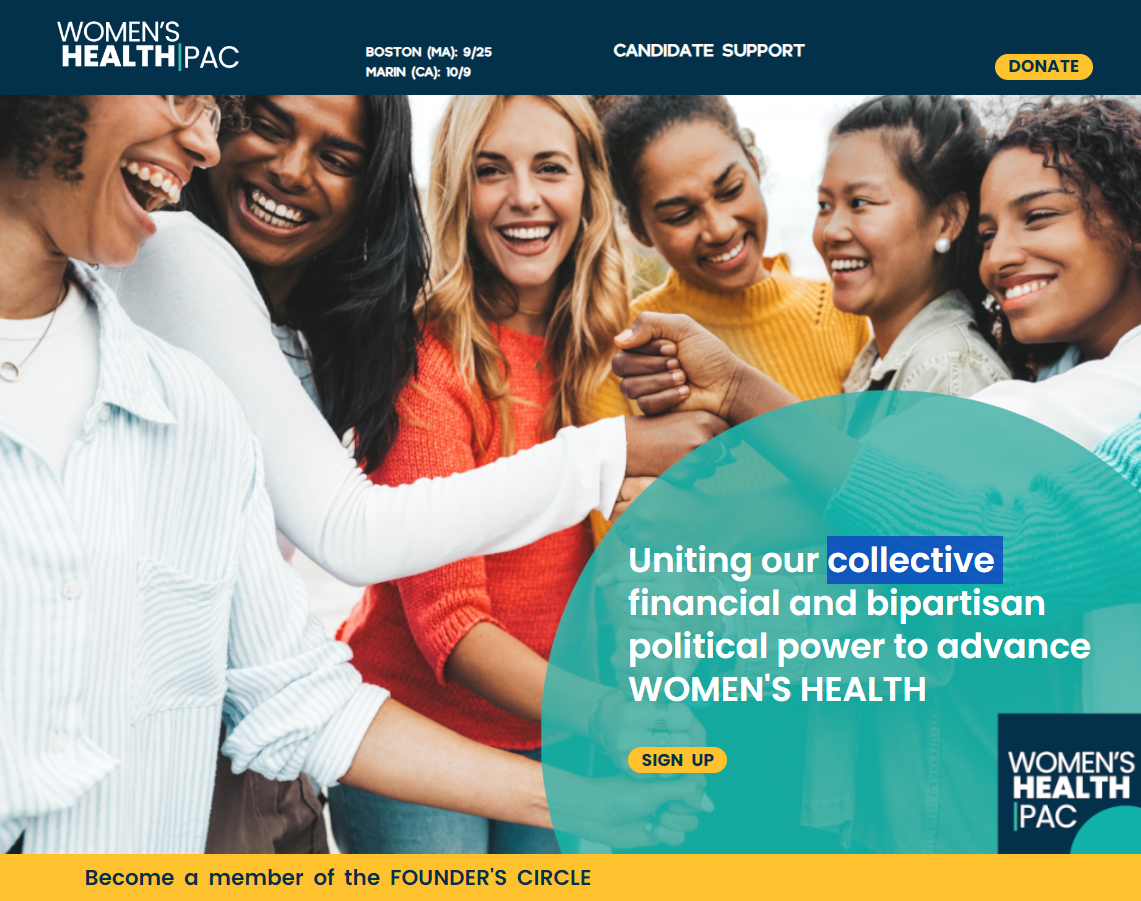

While I was in Boston for the Women’s Health Innovation Summit (WHIS), I had the opportunity to participate in a Women’s Health PAC. We heard from some luminaries in the field, and I left feeling inspired by what they had to say! Below is a synopsis, though keep in mind that I was taking notes on my iPhone at the time, so they are imperfect. Nonetheless, I hope this post will give you a sense of the leaders and the tone they are trying to set for women’s healthcare and policy.
Jamie Zahlaway Belsito is a former State Rep for Massachusetts and Founder of the Maternal Health Leadership Alliance.

Jamie got us off to an energetic start! During her career she has been focused on family and community health, seeking solutions for those that need it the most. And, like many women in this space, came into advocacy work because of her own post-partum experiences. She believes that if the Red Sox can win the World Series, we can achieve our aspirations for women’s health, too!
Mitzi Krockover, MD is Founder, Beyond the Paper Gown & Principal, Golden Seeds.
Dr Krockover affirmed Jamie’s reflections that we all have a personal why. She was the founding director of the UCLA Women’s Health Center in the 1980s, which became a Center of Excellence as defined by Health and Human Services (HHS). It was a government subsidized program. Right after the Revitalization Act in 1993 – requiring women and under-represented groups be included.
At UCLA she had a female patient who smoked pack a day for 20 years, and she had high blood pressure, high cholesterol. She got arm pain every time she walked, but multiple doctors told her it was arthritis. Dr Krockover diagnosed her with stable angina (only on exertion), gave her aspirin and nitro and sent her home. On Monday morning a cardiologist from the ER shared that the patient went from stable angina and unstable angina, and finally got a stress test. Dr Krockover saved that patient’s life; she had been to multiple doctors and not received a diagnosis because clinical understanding of heart disease is centered on the experience of a 70 kg white male.
After UCLA she took a role as the VP of Women’s Health at Humana. It was a crash course in insurance. But it helped underscore the importance of access, especially through insurance. Medicaid expansion to focus on post partum has improved health outcomes, but not all states took it – an interplay between federal and state services. We know that the Affordable Care Act (ACA) also improved health outcomes because of preventive care and contraception. Medicare now covers things like bone density screening. 50% of pregnancies are covered by Medicaid, and whatever CMS does, commercial follows – so that’s really important.
She is focused now in innovation – which is present everywhere. We need the data, we need government funding for research, support for entrepreneurship through NIH and SBIR, and we need help with more sane regulatory processes so it doesn’t take so long to get to market. And we need reimbursement by CMS, because, again, commercial follows. Finally, we need to be able to advertise without censorship on social media and elsewhere.
She has seen throughout her career that that policy and health outcomes are inextricably linked. We have to change policy to see progress.
Dr Krockover made a quick plug for a three part series called Beyond the Ballot: Voting for Women’s Health and Advocating for Change, which is focused on women’s health policy – maternal and reproductive health – sponsored by GLG, Beyond the Paper Gown, Black Women’s Health Imperative, and Healthy Women. You can learn more on her website.

Ramita Tandon, MPH is Chief Clinical Trials Officer at Walgreens.
Ramita took the role at Walgreens to try to make meaningful change, because clinical trials have historically been 75% white. In 1993, Congress passed a law that required the inclusion of women and minorities in clinical research conducted by the NIH. Since then, there has been a greater effort to tackle accessibility and representation in clinical trials.
Walgreens administered 300M vaccines during the pandemic. They serve 100M lives, and 60% of their customers are women making buying and medical decisions for their households. Most people live 5 miles from a pharmacy, and they have 8-9M people in store every day. How can Walgreens bring trials to the communities that those pharmacies serve?
She is two years into the journey now, with 9M patients contacted. They are doing screen diagnostics and blood draws in store for convenience, with the goal of being impactful and inclusive wherever possible. However, in certain parts of the country (like the Deep South), there is still a lot of distrust, and people don’t want to be guinea pigs. We need to talk about the benefits, and educate consumers that trials are part of the continuum of care.
Jodi Neuhauser is co-founder of the Women’s Health PAC and the In Women’s Health community.
Jodi shared that there are other PACs related to women’s health, but they are typically focused in a single disease area. This one is the most comprehensive and it is bipartisan, since the majority of health issues faced by women are non-partisan.

Liz Powell is co-founder of the Women’s Health PAC and G2G Consulting.
In Congress we have 535 elected officials; there are 435 in the House, and 100 in the Senate. There are 23 toss-up elections this cycle, and the PAC now has funding to support 15 candidates – beyond what they originally hoped to do. For the next six weeks the PAC is undertaking a marketing campaign to elevate these issues through candidate conversations – who are more willing to engage when they see we have funding.
Neel Shah, MD, MPP, FACOG is Chief Medical Officer, Maven Clinic.
Dr Shah reminded us that 15 votes may be the margin of victory, and he is astounded that we’ve been able to get reps to listen so quickly. He also reminded us that Trump signed the Preventing Maternal Deaths Act when he was in office – affirming that we can keep a bipartisan focus and get things done, regardless of the outcome of the presidential election.
He has been an ally since his first rotation as an ObGyn in medical school. Living in New Jersey was eye-opening for him – the state has one of the highest incomes in the U.S., but also the highest mortality rate.
His grandparents were involved in the movement to help decolonize India, working with Gandhi. Years later in the U.S., he was raised by two parents who pursued the American Dream. Dr Shah and his wife are also politically active; they worked on competing phone banks for Obama and Clinton during the first digital campaign – from which he learned a lot.
As a medical student he was interested in policy. He recognized some of the discriminatory language around Medicaid, which is associated with poverty, versus Medicare “because you earned it”. He spent six months in different locations around the U.S. and he was shocked to see maternity mortality rates continuing to climb. He began to realize that we needed to do more than evolve the system as it is – we need to revolutionize.
He received a call from Kate Ryder, who is the CEO of the Maven Clinic. Today, Maven is the world’s largest virtual clinic for women’s and family health, serving 17M lives in 175 countries. They just recently acquired Amazon as a customer, and Amazon is such a large employer that there is a new Amazon baby every 18 minutes!
He said that it’s less affordable and more dangerous to start a family in the U.S. today than in many other places in the world; it’s more dangerous to give birth in the Florida panhandle than it is to give birth in Kenya.
Dr Shah feels that women’s health in the U.S. today is where HIV and AIDS were in the 1980s. It is scary – terrifying – and deadly, especially for people that are already disenfranchised. Our work in women’s health reminds him of a prize-winning book about the AIDS epidemic called Let the Record Show, which is an oral history of ACT UP. Their radical activism transformed the landscape of HIV and AIDS policy and care in just six years. Personally this lens resonated with me, because, as I mentioned in an earlier post, political inaction during the Reagan administration resulted in devasting losses of an entire generation of gay men.
Beth Garner, MD, MPH is President, KNI Health Consultants, LLC and Immediate Past President, American Medical Women’s Association.
I found what Dr Garner had to say incredibly powerful. I keep ruminating on it, calling it the Baby Ruth Manifesto in my head. I was lucky enough to catch Dr Garner briefly following her presentation, and she gave me her speaker notes! I’m so pleased to be able to share her closing thoughts from the Boston PAC meeting with you in their entirety:
Good evening everyone – so excited to see you all and thank you so much for being her tonight.
I want to echo what Liz says: this is not a moment, it’s a movement, and we are creating a mandate for change. I’ve been on a high for over a year now because of all that is happening and I think I just need to realize that perhaps this is the new normal for us in women’s health and I am FINE with that because we have real work to do to realize the future that we all envision is possible.
I’ve been asked to speak briefly about Why Women’s Health. To me, Why Women’s Health is all about the future, so rather than stand up her and regurgitating the data that probably most of you already know, I’m going to make this personal and I’m going to using the data indirectly in a way that
I hope will help us all envision the world that we believe can become a reality because of all the hard work we are doing today.
So … I recently became a grandmother of a beautiful baby girl, Ruth. Right now, she is a happy 4 month-old whose family adores her, makes sure her every need is met and who wants the best for her throughout her life. I can’t help but worry though when it comes to her health across her lifespan and think a lot about and hope that the world she lives in is very different from where we are today.
Ruth deserves to live in a world in which the health of women is valued, and that women’s health is not considered a niche market.
I envision a world in which wherever she lives, she has access to safe, equitable, holistic, healthcare, in which she can openly talk about her health issues without stigma, and where her healthcare providers believe her and don’t tell her it’s all in her head when she says she is in pain.
Ruth deserves a world in which we understand the fundamental science around the basics of period pain, PCOS, pregnancy if she should choose it, endometriosis if she happens to be in that 1 in 10 in who has it, and so on across her entire lifespan.
She deserves a world in which we understand the differences between the sexes and why women are more likely to develop autoimmune disease, Alzheimer’s disease, are more likely to die in the year following a heart attack than men, and in which we have targeted treatments and cures for these conditions.
I envision a world in which she does not spend 25% of her life in poor[er] health than her male counterparts.
I also envision a world in which the reimbursement for a surgical procedure done for her is equal to the same procedure done for a man (that’s not the case today).
I hope for this world, not just for Ruth, but for her future family should she have one, for the community in which she lives, and for society – because when women are healthy, everyone benefits.
Imagine that world – can we get there – l believe we can. With all of the incredible leaders in this coalition advocating for change, I am as optimistic as I have ever been for the future of the health of women, and that is Why Women’s Health.

Leave a Reply