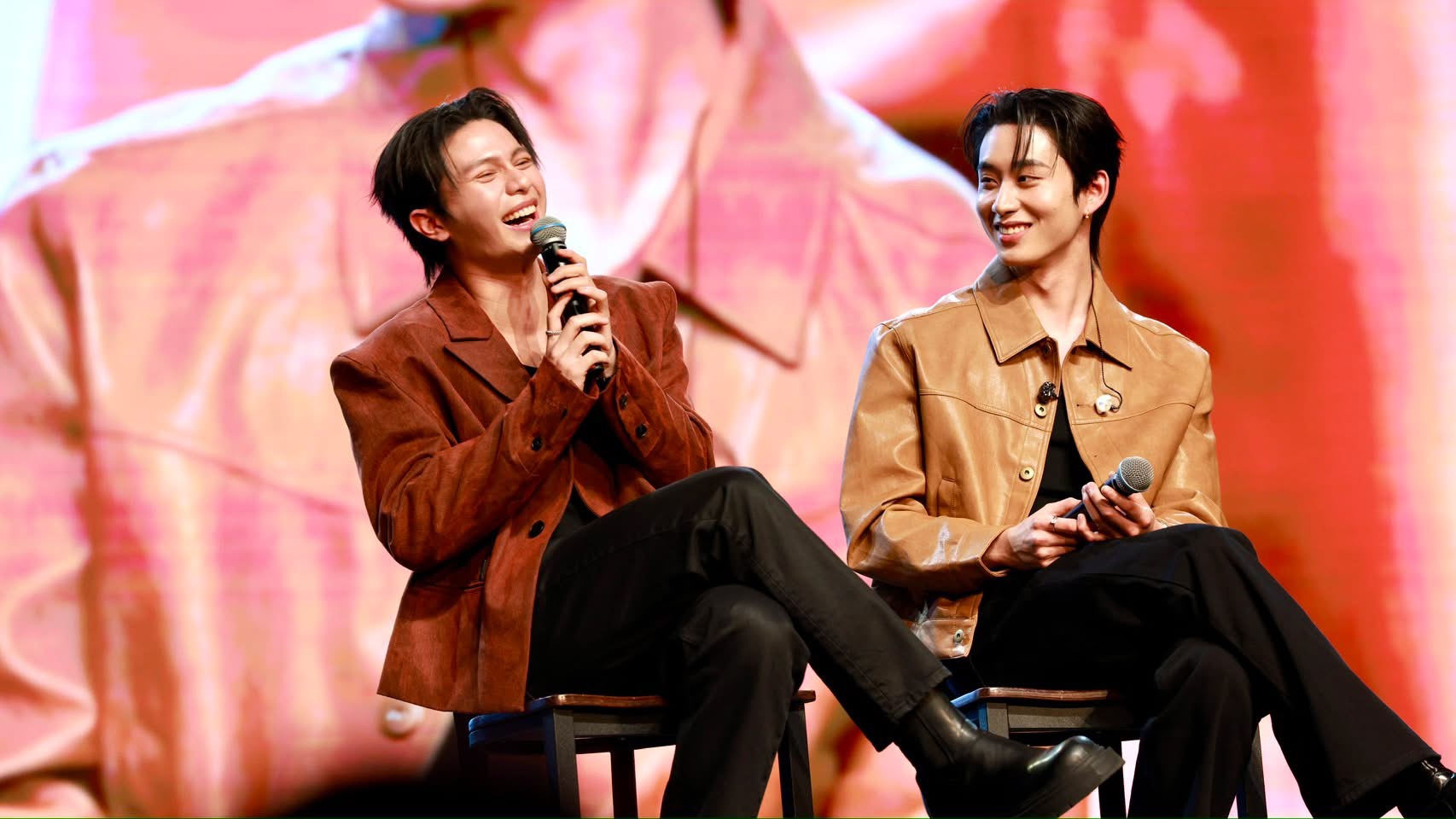
If you haven’t heard of Heated Rivalry, you’ve either been living under a rock or spending too much time on LinkedIn. Sadly, if you’re reading this it’s probably the latter. 😂

Heated Rivalry is a romance about two rival hockey players that was turned into a television series, and last year it was everywhere. I was hooked from the first episode. It was a good story, made terrific by the acting. That show led me down a rabbit hole into the Asian genre of romance between two men called BL, or Boys’ Love. These stories have their roots in Japanese manga and a current center of gravity in Thailand’s entertainment industry. Three months ago I had never watched one, but now I can tell you more about it than I can about any television I’ve watched in my adult life (which until recently was close to none).
As a kid I was only allowed 90 minutes of television time per week. I suppose that’s why I became a bookworm, and not a TV or movie person. During the pandemic, though, I started watching anime with my kids and we haven’t stopped; we’re currently watching eighteen different shows at the moment. I’ve enjoyed my foray into anime. I love the time with my kids and discussing everything about the genre with them. The subtitles (no dub for us!) make it easy to follow along. The art is incredibly compelling at times, and I’ve found lots of new music through the OSTs, as well. So when I first learned about BL, I started with the anime Dakaichi, then hunted down Top Form, its Thai live-action remake, to see how the two compared. That was the door into Thai BL, and I have not really found my way back out.
I’ve enjoyed almost everything I’ve watched, though there wasn’t one single show that sucked me in. I suppose that it’s the anthropologist in me that has enjoyed discovering how differently each country tells the same kind of story. Japanese BL is the most faithful to the genre’s origins — restrained, gorgeously shot, slice-of-life, sometimes a single kiss across an entire series, and so much character work that you don’t miss the rest. A Japanese actor might do one BL and never appear in another. The Thai BL industry is the loudest and most elaborate, with acting pairs and ensembles and a serious music industry attached, performers singing the soundtracks for the shows in which they appear. Korean BL is closer to the Japanese style in restraint. Chinese BL comes in fits and starts. The Chinese have produced some of the most beautiful historical storytelling I’ve seen. But the shows are created under a government that does not condone the relationships it depicts, which makes the same art quietly dangerous for the people who make it.
After a lifetime of Western queer stories where suffering is the point, I love that in BLs, homophobia is usually not central to the story. There is plenty of coming-of-age and coming-out, because the characters being depicted are usually high-school and college-aged. But the engine of the narrative isn’t the pain of being gay — it’s just the love. That reordering still surprises and delights me every time.
I also love the rituals. Thai BL especially has its recurring scenes — the sponge bath, the feeding-each-other, the fight that ends with one tending to the other, the inevitable jump into water at the beach or in a bath. I’ve half-seriously thought about building an Instagram account around nothing but the food scenes. As an anthropologist, this is catnip: I get to observe Buddhism, the food, the clothes, the way families speak to each other, the rhythms of university life. I came for the romance and stayed, in part, for the perspective on other cultures that aren’t well known to me.

And then there are the parts I don’t love.
Somewhere in the rabbit hole I learned the word ship — short for the manufactured couple at the center of Thai BL. It is largely a Thai invention; the studios pioneered marketing two actors as an “imaginary couple,” a CP, a brand. They pair performers who are comfortable together and put them in show after show, falling in love on camera year after year. The fans want to believe the pairings are real — that is what the fan service and the skinship are for — and the actors want a successful pairing because it drives the fandom, the visibility, the work, and eventually the money. I use the word pairing on purpose, because that is what it is: a product.
The human complications pile up fast. Take EarthMix — Earth and Mix — who have worked together for years. They live together; like idols, they are not supposed to date outside the pairing. I find myself wondering what it does to a person to fall in love on camera, with the same partner, again and again, for years. Is a private life on hold while the pairing is in the public eye? What happens when one of them is gay and the other straight — when one is pining and the other is only acting? When PondPhuwin sat down with the Zach Sang Show, Phuwin described the note their studio gave them starting out — not to think of it as a queer story or an LGBT movie, but to approach it with “the same mindset that people have of heteros,” and let the acting follow. Maybe … but a love story doesn’t usually require you to keep performing it off-screen.

The part that unsettles me most is the impact on young performers. It isn’t William’s age that stays with me — he was nineteen when he filmed ThamePo. But it seems a little sad that for some of the younger actors, their first kiss is on screen. And for a queer or questioning young person, the line between the role and the self is deliberately, profitably blurred. The opening shot of one ThamePo music video is a phone screen that reads “William” — the actor’s real name, not his character’s.

In an interview, he mentioned buying a house with Est, his screen partner. They release love songs as a pair. And when the show itself mirrors his real life — his actual band were his castmates — the lines blur in every direction at once. I am not claiming to know what is true between any two of them, but it’s clear that the blurring is the strategy, and the people who are acting and receiving those messages are all very young.
Top Form, the show that pulled me in, was performed by SmartBoom — and within months of it airing, their partnership fractured in a public dispute between their agencies, the two of them visibly caught in the middle. I felt for Boom; Smart had a music career, but Boom is primarily an actor. Without a strong pairing his performance options narrowed overnight. In contrast, Pond Ponlawit (who moves across genres and partners instead of locking into a single branded CP) is an exception to the madness that is Thai BL pairings. He most recently led Reset opposite Peterpan — talented enough to get away with it and, as far as I know, nearly alone in making that choice and still thriving. Put Boom and Pond Ponlawit next to each other and you understand why the pairing matters so much. It is not only something done to actors. It is the economic structure they are asked to operate in.
I also don’t love how rigidly the roles are gendered — the dominant top and the softer, submissive bottom, and the way fans police which is which. The pairing concept is baked in so deep that the first name in a pairing usually signals the top. Noeul, of BossNoeul, after posting a photo that showed how physically fit he’d gotten, pushed back on fans who treated it as a betrayal of his assigned role. His body is his own, he said, regardless of the roles he is cast in. Western MM romance, for all its faults, leaves more room for men who are versatile (vers) or simply both.
The audience is part of the difference. The MM romance readers I know are mostly middle-aged women of every orientation, and BL skews much younger. I have watched fans introduce themselves at thirteen, fifteen; the ones who are my age are fewer (or quieter). I suspect the age is where the intensity comes from — these are kids who haven’t had their own relationships yet. They are still starry-eyed about finding their person, sometimes genuinely unable to appreciate the line between fiction and reality. The chasing, the stalking, the meltdowns when a pairing changes — it is immature, and honestly it is a little embarrassing to be associated with.
And then I have to be honest about my own experience of these dynamics. I have pairings I prefer, pairings where I privately think one is too good for the other, or where I don’t think they fit together as a couple. When I see “my” actor cast with someone new, it feels like a betrayal in a way I have never experienced watching a Hollywood couple. I bailed on one drama partly because well-known pairings were dabbling in other relationships before finding their way to each other, and it made me uncomfortable. So, I don’t love what this pairing culture brings out in me.
Step back far enough and it’s important to acknowledge that the whole thing is an export. Thailand is doing with BL something close to what Korea did with K-pop — building soft power out of romance. Much of it is free on YouTube precisely because the non-Asian market is small by comparison, which quietly inverts the usual arrangement. Here, Asia is the producer and the West is a secondary consumer.
The two countries that shaped my view of BL split from almost the same starting line. In 2016, Thailand released SOTUS and China released Addicted. Both were campus romances. Thailand built an industry on it; the global explosion came in 2020, when 2gether turned BrightWin into “the quarantine couple” and put Thai BL on screens around the world. China did the opposite. Addicted was pulled from every platform three episodes short of its finale, and its two young leads, Huang Jingyu and Xu Weizhou, were quietly barred from ever appearing together again. Their last public moment as a pair was broken up by security at a fan event in Thailand. Since then the clampdown only hardened; adaptations now smuggle romance in as “bromance” to slip past the censors, and as recently as 2024 and 2025 the state has been arresting and jailing danmei authors, most of them young women. The same art has very different stakes for the people inside it. Thailand’s marriage equality law took effect in January 2025; in China, writing the wrong love story can land you in prison.
There is one more discomfort I can’t resolve, which as an anthropologist I feel is important to acknowledge. There is a long literature on the way Western, usually white, men fetishize East Asian women — the “Lotus Blossom” fantasy of the docile, exotic other, rooted in a history of war, empire, and the objectifying male gaze. The philosopher Robin Zheng has written about why such “preferences” are not the compliment they appear to be; they treat a person as an interchangeable instance of a category rather than as herself. What I am watching is something close to the mirror image — largely young women fixated on young Asian men, which is not any better.
Here is what keeps me watching anyway, through all of it: the same thing the books gave me — queer love allowed to exist, allowed to win, filmed as ordinary and beautiful — plus a window into lives I would never otherwise see. I still can’t tell you whether you can love this genre without feeding the machine that grinds up the young people who make it. I don’t have the answer, and I’m not pretending otherwise. But I am thoroughly enjoying it.
I’ve started keeping a record of what I watch — and read — on Instagram, @natreads247. Yes, including the food scenes. Come find me, and if you’ve made your peace with it — in this fandom or any other — tell me how.
Leave a Reply