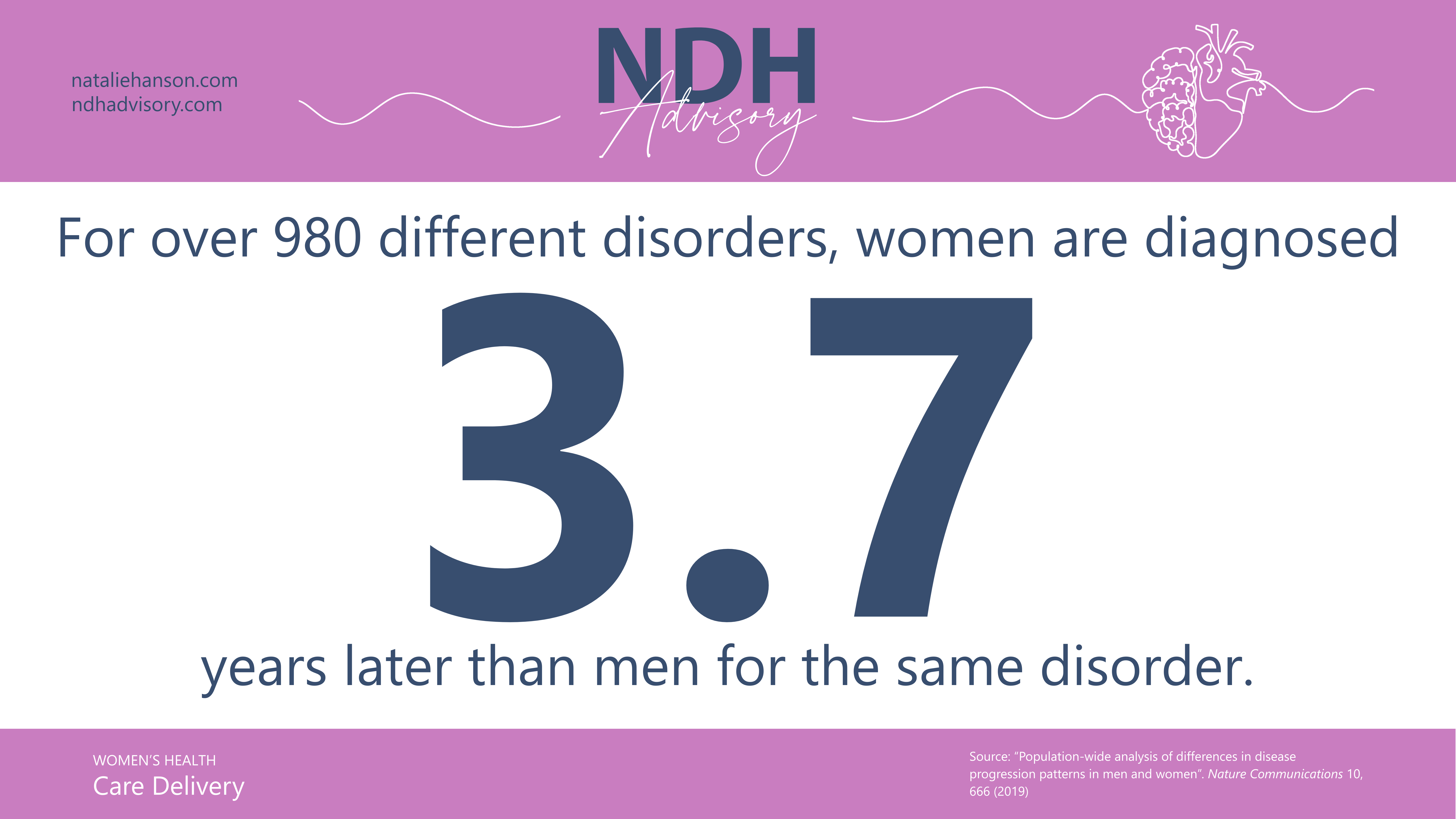
Women are diagnosed several years later than men for hundreds of different conditions, even though men have the tendency to go to the doctor later. In addition to the study referenced in my graphic, a Danish dataset studied millions of patients, 770+ diseases, and an average ~4 year gap in diagnoses between hospitalized men and women.
“Women are diagnosed later for heart disease, not only because it is still largely considered a ‘man’s disease’, but also because our diagnostic tests are male-biased, in terms in terms of ‘typical’ being the male presentation.” However, when “men get diseases that most healthcare professionals consider ‘women’s diseases,’ they are diagnosed at later, more serious stages” as well.
There seem to be three big reasons for the diagnosis gap (1) clinical bias – healthcare providers more readily attribute women’s symptoms to psychological factors (2) physician education – limited training on female anatomy and conditions, combined with research and guidelines skew towards typical male symptoms, (3) structural constraints – short visits, complexity of diagnosing chronic conditions, and more.
All of this of course means that by the time women get diagnosed, their diseases have progressed, requiring more aggressive treatment, and resulting in higher mortality rates. And of course the ensuing self doubt, erosion of trust in our healthcare system, and therefor further disengagement from care.
Women deserve to be believed the first time, diagnosed the first time, and treated in a timely way. But closing this diagnosis gap will take research, training, and policy changes – most of all, it will take all of us refusing to accept the status quo.
Leave a Reply