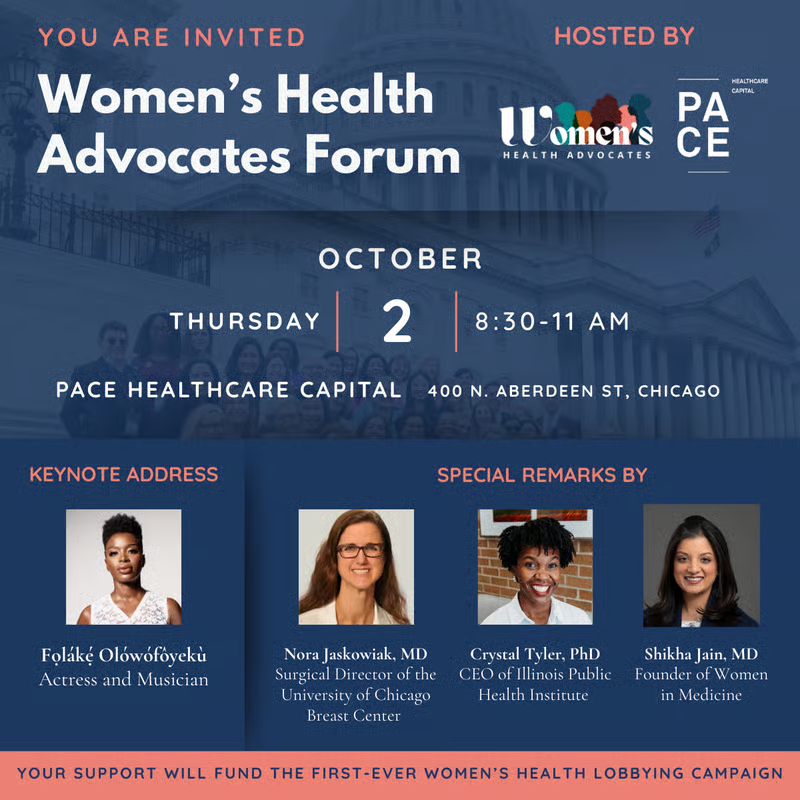
A recap of an engaging breakfast event organized by Women’s Health Advocates (WHA) in Chicago and sponsored by PACE Healthcare Capital.
I am still buzzing from the incredible energy and esprit de corps in the room yesterday! Seeing so many women (and some male allies) in Chicago mobilized around women’s health was so inspiring! I wrote a short recap of the Fọlákẹ́ Olówófôyekù’s keynote for LinkedIn, but this post (also available on Substack) covers all the event content – opening remarks, keynote, moderated panel, and closing remarks. Enjoy!
Opening Remarks
Liz Powell is the founder of Women’s Health Advocates (WHA) which is a bi-partisan organization focused on advocacy and policy for women’s health. She reminded us that while women’s health has historically been focused on “boobs and tubes”, the definition of women’s health is diseases that solely, disproportionately, and/or differently affect the health of women, head to toe, over the lifespan.
Liz passed the mic to Dr Beth Garner, who shared why she left her role as a practicing ObGyn nearly twenty years ago; she loved the work, but was increasingly frustrated that doctors were treating symptoms rather than the underlying reasons people were getting sick.
Dr Garner made the leap to industry where she helped launch the Gardasil vaccine for the Human Papillomavirus (HPV) in 2006. She went on to work with smaller companies and realized that the underlying problem in women’s health is “decades and decades” of inadequate funding.
She was again inspired by the way her father’s metastatic lung cancer was treated, but frustrated that we aren’t doing more with targeted therapeutics in women’s health; in order to have such targeted therapies, you need fundamental science on women’s bodies which is still largely absent today.
While the business case has now been made clear – and seems to be well understood by investors – there is still so much advocacy work needed. Dr Garner was part of the first Women’s Health Capitol Hill Day, which included a congressional briefing and meetings with 25 congressional offices. Engagement was high, and they asked how to help, and the dialogue is now ongoing.
Julia Monfrini Peev is the Managing Partner at PACE Healthcare Capital. As the local event host, she shared her firm’s commitment to women’s health – not just as patients, but as care-givers, decision-makers, and practitioners. In the U.S. today, 67% of healthcare workers are women. PACE invested in Alloy Health (in the menopause space) four years ago; they are now a national voice for perimenopause and menopause.
Julia believes it’s not just a moral imperative, but “a once-in-a-generation business opportunity” where “capital meets conviction meets purpose”.
Dr Shika Jain is a medical oncologist, and she shared her journey as a practitioner and founder of Women in Medicine. She organized her first Summit was in 2019, and 450 people attended. While she remains Chicago-based, her work is now national and has has evolved into more work with the media. Research shows that female physicians have better outcomes, female surgeons have less complications, less readmissions to the hospital, etc; we need more women not just in medicine but in leadership positions.
In retrospect she can see how much organizations like Women in Medicine and Women’s Health Advocates are needed; we need to elevate women to drive change and improve health outcomes. We need to help change the narrative, and change the system to create the one we all deserve. We can do our part to help fight misinformation.
You have a pocketbook but you also have a voice. Your voice is just as powerful; you don’t know the ripple effect of the conversations you have, the people you meet.
Sarah Austin is Founder & CEO of Scratch Pantry. She was one of the organizers of the Chicago WHA event, and she got up to share her story and introduce the keynote speaker. Sarah shared that her daughter had endometriosis, but after living with daily pain for almost four years, she took her own life at the age of 18. Sarah has been advocating for the Endometriosis Foundation in New York in the years since, and is now also part of the Endo Coalition with WHA, where she is helping to draft a bill to take to Congress.
Sarah introduced our keynote speaker, Fọlákẹ́ Olówófôyekù (pronounced fe-LA-ke). Sarah said “her presence is unforgettable, her spirit regal, and her story is inspiring. She stepped off of Broadway to join us. She is a performing artist, model, actress, and musician; she played bass for David Bowie.” Fọlákẹ́ voiced Amara in Disney’s animated movie Mufasa: The Lion King. She has been a guest on countless television shows, and had a starring role CBS sitcom Bob Hearts Abishola. She was born and raised in Nigeria as the youngest of 20 children, and she joined us as the keynote speaker because she spent more than two decades living with endometriosis before receiving a diagnosis and proper care.
Keynote

As someone living with endometriosis, Fọlákẹ́ expressed her gratitude that she can turn her pain into purpose. For the men in the room, she provided a brief but graphic description of what that pain might feel like with male anatomy. The pain (which feels like muscles tearing) can last for hours, and sometimes it’s a daily occurrence.
Raised in rural Nigeria, she was the youngest of 20 children, 16 of them boys. She was a baby sister surrounded by strong personalities! She was “a badass African Amazon, highly intelligent and resourceful”, and learned to survive in her surroundings, while under military rule. By the age of ten she was in boarding school, taking beatings from grown men; she still has the resulting scars on her palms. But this tough and harsh foundation helped prepare her for the life ahead – by age 24 she had lost both of her parents.
Even as she was facing all those challenges, she was carrying another invisible burden. She had her first taste of chronic pain at the age of 13, and she didn’t experience any relief for 25 years. As tough, as athletic, and as resilient as she was, nothing has brought her to her knees like that; all the harshness she experienced couldn’t equal the anguish of living with that pain for so long.
She came to the U.S. and pursued a degree in theater in New York. It was through her publicist she finally found a doctor who could help, but her insurance was unwilling to cover the procedure. It was due to her starring role in Bob Hearts Abishola that she was finally able to afford the six-hour surgery. Three years later, 95% of the pain is gone, but she still wonders whether the pain will come back, and, when it does, will we have made enough advancements to treat it more effectively? Will we have a cure? With the WHA she sees a lot of hope, and so she hopes the answer will be yes.
Her story is just one – there are millions of women globally dealing with this and looking for a cure. Their blank stares hide the worst pain imaginable. How do we turn that chorus of voices into change?
We engage with groups like WHA who are fighting for our rights and medical research, we participate in shaping bills that protect our health, we write to our representatives. And if all else fails, we have a sex strike!
Let’s refuse to stay silent, refuse to accept dismissal. We deserve better, our bodies matter – our bodies sustain the species.
Panel
Dr Shikha Jain, MD, FACP, facilitated a panel with Dr Barbra Hanna, DO, MSCP, Dr Nora Jaskowiak, MD, and Crystal Tyler, PhD.

Panelist Introductions
Dr Hanna is a Menopause Society certified practitioner, and the CEO & Founder of a telehealth company called MenopauseRx. Her goal is to improve access to care. Dr Jaskowiak is a breast cancer surgeon at the University of Chicago. She treats primarily women but some men too. She feels she was put on the planet to care for the individual women, on patient at a time. In addition to teaching and work on breast imaging, she has worked with the Bionic Breast project, to help women regain feeling in their breasts. Dr Tyler is a reproductive and perinatal epidemiologist. She started her career at the CDC, and she has since worked in reproductive health, rights, and justice. Today she is the CEO of the Illinois Public Health Institute.
The Panel
Fact: Not until 1993 were women required to be included in NIH funded research. As a result, physicians don’t know if they are treating you properly. For example, symptoms of cardiac arrest are so different between women and men that women often go undiagnosed and untreated while having a heart attack.
Dr Jain’s first question to the panel is what the biggest challenge is facing women’s health, along with one or more proposed solutions?
Dr Hanna doesn’t believe the issue is lack of research, but rather lack of access to care from individuals who understand the research that does exist. We heard Fọlákẹ́;s story earlier – until she was employed she had no access to a physician who understood endometriosis. As an ObGyn that makes her cringe. That training was baked into her residency program; it needs to start in training, continue in residency. And physicians may not have all the solutions, but even if they are embarrassed, they should guide patients to those that do have the answers. So she believes the challenge is in improving education and physician capabilities.
Dr Jaskowiak said that there are so many challenges that it’s easy to focus our respective areas. Yes, education needs to improve. And all doctors need to learn to respect and listen to women and their problems. But even before that, women have to understand that their own health and problems are important. So many of the patients she has met have never done genetics testing. That has to come much earlier, and that education – and the willingness to advocate for herself and her family – has to happen sooner. Early intervention could prevent so many advanced breast cancer cases. We need education and self-respect, and we need to advocate for ourselves and for each other.
Dr Tyler argued that many of us are not seen. Full stop. What is happening across our country, in our cities – people being hunted like wild animals and snatched off the street. The Dobbs decision was not about abortion but about rights to our bodies. We are not seen as individuals worthy of diagnosis, pain management, or what we need to live and thrive. We are not just “boobs and tubes”, and this is about more than healthcare. Health is not determined by healthcare, but all our circumstances, and we are watching things being eroded, taken away. We need to fight.
Dr Jain was in the hospital, pregnant with twins, and she almost died in the hospital where she was working as an attending physician. She is triple-Board certified, but she was not listened to when she verbalized that she was at risk of dying.
—
Fact: Over 50% of individuals in medical school identify as women, but less than 30% of CEOs, deans, etc, are women. Women’s health initiatives are drive by women, so we need to drive changes in workforce, and keep women there.
Whatever your political leaning, she doesn’t care; what is happening in the world is scary. When you look at the news, there is a fire a minute. How to focus ourselves and actually drive change. It’s like the meme, standing in front of a dumpster fire and saying “everything is fine”. She had a patient that was afraid to come to her office for medical treatment, fearing he would be snatched off the street.
Dr Jain’s question for the panel – with everything burning around us, how do we make sure our efforts are actually driving change?
Dr Tyler reminded us that while revolution is being televised now, people are just now seeing what others have been dealing with for years, decades, centuries. This is NOT NEW. Since the founding of this country, people before and after her got through. Yes, as a leader, advocate, mother it’s exhausting to sit and be in what is happening. But she can’t wallow, she has work to do. We chose the field because we know it matters, so she tells her team to get back to work. The fear doesn’t deter her. It was even worse for many years, this is not new.
Dr Jaskowiak said that when you listen to the news on your way into work, your head starts spinning? How am I going to manage this? Caring or advocating are her coping mechanisms. But also gatherings like this, inspired by people like Liz and Dr Jain. It takes energy to bring people together, but we have to fight this and find ways to organize – we can’t just stand aside.
Dr Hanna rolls up her sleeves and doubles down on her mission. She stays focused on what she can control (within her microcosm) – really listening, personalizing for each unique individual. She stays focused on moving forward, on not getting caught up in the political drama. She is purposefully isolating from that noise so she can focus her energy on the mission – helping women improve their health, their lives. It’s not an answer for people being swept off the streets but she can’t control that. So she focuses on what she can do well.
—
Fact: During the pandemic, countries led by women had the best outcomes, the lowest rates of transmission. Around the same time, a McKinsey found that women leaders had higher retention, higher satisfaction amongst their employees. Yet, over a third – almost 50% of the women – felt those efforts were not being recognized. They were overlooked, they were being voluntold, and a third were planning to leave their jobs.
Dr Jain’s question for the panel – How do you maintain your mental health? What do you do to continue driving the work forward while also protecting your own health and mental health?
She started working out again, she needed it for her mental health. During the pandemic she neglected to take care of herself. She puts her phone away to stop doom-scrolling.
Dr Jaskowiak said that exercise is really important – she does pilates. Before the pandemic she used to take live classes, now she does it over Zoom. Being in nature is also super important. This weekend she went to the Monstrose bird sanctuary with a lovely group of people. For her personally, music and theater are important. She and her husbands are supporters of Grant Park – their Music Festival is free for everyone. She is happy to be in a group of appreciative people sharing an experience in our great city. It is how she got through the summer and some of the craziness.
Dr Tyler. Smut! She’s reading smut these days. And getting out in nature to read smut!
Dr Hanna said movement is medicine, and we can do it for free. Clinical trials show that just going for a walk – shifting eyes to see greenery in the neighborhood – helps to improve mood. She likes to run, though she is not fast or pretty. But she likes to sweat, and the more she sweats the more her mental health improves. As she ages nos she is doing more weight training as well. So yes, movement is medicine.
Dr Jain said she is also very attractive when she runs. She and her kids ran a 3K for the first time this week, the boys got 3rd and 4th place, so she thinks they’ll be doing more of that.
—
Dr Jain asked the panel to offer one final thought or take home for the audience.
Dr Hanna encouraged us to look around the room, soak in the importance of coming together to move women’s healthcare forward. Collectively, we’re bad-ass!
Jr Jaskowiak reminded us to stay positive, acknowledge what is going on, but don’t get weighed down thinking you have to solve everything. We all have our strengths, focus your positive energy on trying to solve what you have control over.
Dr Tyler said we should take responsibility for ourselves, but also take responsibility for our peers, our sisters and brothers, and others whose pronouns are not s/he. People have been focused on themselves, but we need to see ourselves in others, and fight for others as we would fight for ourselves.
Dr Jain said that rhetoric has been very hostile, and that people who differ in opinion are having a harder time talking to one another. In kindergarten she was taught the golden rule – which treat others the way you want to be treated. She is teaching her children and colleagues how to respectfully disagree.
We need to fight for belonging. But we need to come back to a time where we can talk to each other and remember the humanity in each of us. Because at the end of the day, we are all humans. And we all want what’s best for our neighbors, I hope. Our friends, our family, our loved ones.
So whenever she talks about these things she falls back on the science, the data, the humanity. Because at the end of the day we are one human race, regardless of how we look, where we come form. We should all be working to lift each other up.
Her homework for us is to have these dialogues, these hard conversations. We need to put ourselves in uncomfortable situations, and figure out how to advocate and drive changes in policy. Speaking truth to power is so relevant to our current time. But we need to keep advocating for change, because if we don’t do it, no one is going to do it for us.
Closing Remarks
Liz Powell reminded us to attend the standing WHA call, which is at noon Eastern on the first Wednesday of every month. She shares what is happening in Washington, and what to do about it – sending emails, visiting DC, attending events. Chicagoland is a powerhouse, one of the leaders for the WHA.
NOTE: There is another event (a Happy Hour) scheduled on November 20th, there will be a Luma link available to sign up.
Liz offered a heartfelt thanks for the day. The power of our voices is so important in these challenging times. Every day there is a new Executive Order and racist, sexist remarks – but there are also glimmers of hope. The team has been lobbying since the beginning of the year to educate and advocate on these women’s health gaps and ways to close them. Today across all 27 NIH institutes and centers, only 8% is focused on women’s health. That’s not acceptable – we need more funding for women’s health research. Do you know that less than 5% of all clinical trial participants are Black women. Not acceptable. And even today, women are still under represented in trials.
They are working hard to educate and advocate on topics like heart disease. In both the Senate and the House there are funding bills for all health issues. The Office of Research on Women’s Health secured a $30 million increase, in an environment in which President Trump was proposing to slash budgets by 40%. In the House they have a $26 million increase. So there will be a negotiation between those two, but either way there will be an increase. And these bills use the official definition of women’s health, too. There is $500M in women’s health research coming of the Department of Defense (DOD) as well. They are just as committed to pushing women’s health research forward.
And all this happens because we share. We share our stories, we share facts. And our leadership is also super important. So our voices matter in whatever way we can contribute.
They have an online advocacy tool where you type in your address and then you can select issues you want to write about. She would recommend focusing on funding to help push those bills through the House and the Senate, and then the second is for Breast Cancer Awareness Month; the Find It Early Act provides for comprehensive mammograms and supplemental screening. We know that these cancers are 90% survivable if they are caught early. 40-50% of us have dense breasts which require additional screening, but today only half the states provide coverage for that.
Everyone deserves care – rich, poor, Black, white – and we can do something about it, we can change that if we raise our voices.
Thank you for being part of the movement.

Leave a Reply