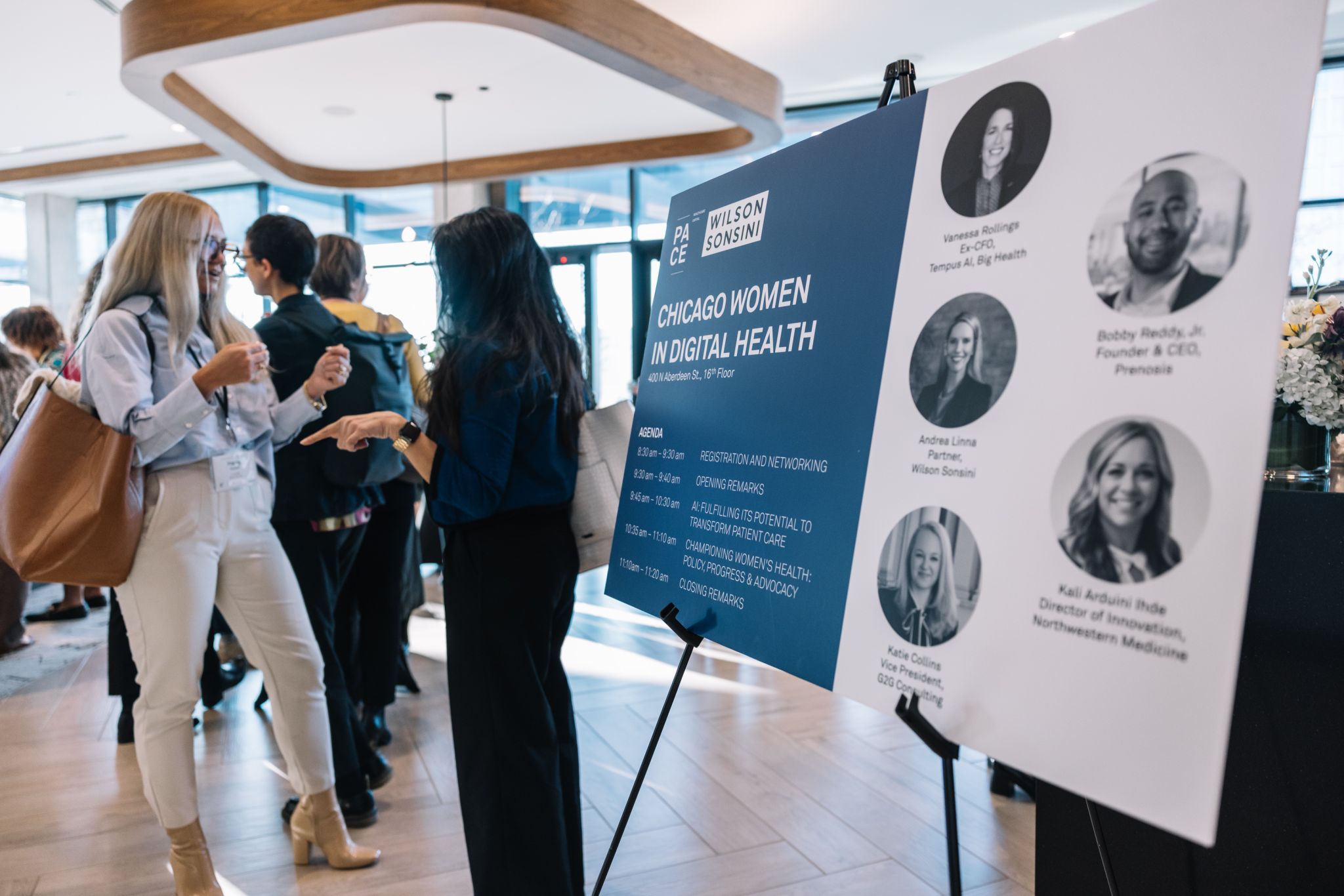

Last week I had the privilege of attending a Chicago Women in Digital Health event, hosted by PACE Healthcare Capital, and sponsored by Wilson Sonsini. Unsurprisingly, the room was packed with talented and capable women and few brave male allies. The networking conversations were mutually curious and engaging, and the panels were thought provoking.

AI: Fulfilling Its Potential to Transform Patient Care, moderated by Vanessa Rollings with Kali Arduini Idhe and Bobby Reddy Jr. PhD.
Kali is the Director of Innovation at Northwestern Medicine. She and her team regularly evaluate tools of all kinds, but a major focus is reducing administrative burden on physicians so they can focus on patient care. Bobby is the co-founder and CEO of Prenosis, an AI solution that facilitates sepsis diagnosis and enables actionable decisions in the hospital. [Note: Sepsis is the leading cause of death in hospitals, so addressing it offers substantial benefits to hospitals, physicians, payers, and patients alike.]
Physician behavior change. Kali shared that change management remains a “huge component” of their work. Their deployment efforts focus on making solutions usable and embedded in how physicians work. Bobby concurred that 95% of the work is adoption, and in his experience that is about trust – physicians need to know that the solution works properly, that it will improve their work life, and that it won’t take over their job. The technology is only an enabler for what are often life-changing decisions. Prenosis achieves trust through (1) external validation such as FDA approval, (2) transparency about how the results or recommendations were achieved, and (3) monitoring the tool after commercialization to ensure that it is delivering actual results and value to the customer.
Representation in and traceability of data. Kali’s team at Northwestern Medicine will not engage with vendors who can’t explain their algorithm and the data it was trained on; a key part of their process is working with their own data scientists to dig into the dataset that was used to train the model. Prenosis built a biobank and uses that de-identified patient data in their work. Bobby shared that good representation of sub-populations is important for FDA approval, as is ongoing commitment to re-evaluate post-commercialization. Over time, Prenosis has withdrawn features that don’t work consistently across populations; they have learned that generalizability was more valuable than features with inconsistent benefits across populations.
Transparent decision-making. Bobby shared that the recommendations without data doesn’t build trust and intuition. With GPS, over time we have adapted to following instructions rather than reading maps. At Northwestern Medicine, they enable physicians to see the raw outputs – transcripts, tags on an image so it is clear what is being referenced. This transparency builds trust, but in a few years from now that level of detail may no longer be required.
End-user engagement. Northwestern Medicine has seven patient experience councils in different regions with varied demographics. Before they initiated any AI-enabled programs, they asked patients what they would need to feel comfortable. During implementation at Northwestern Medicine, physicians are also engaged and provide feedback until the solution is optimized for their work. The Prenosis team ran Human Factors studies on the interface, ensuring that over time it will integrate seamlessly with physician intuition. Only by engaging with end-user were they able to evaluate what information was critical, how to avoid overwhelm.

Championing Women’s Health: Policy, Progress & Advocacy, with Katie Collins moderated by Andrea Linna.
Katie has spent twenty years working in federal agencies and non-profits, including NIH biomedical research funding and the White House. She and Andrea discussed women’s health and policy in the new administration.
Consistent with what I have heard from Liz Powell with the Women’s Health PAC, Katie advocates for separating reproductive health from women’s health – at least for now. We know reproductive health is key, but in this environment it is “not touchable”. However, we want to capitalize on the groundswell movement in women’s health of the past year, and continue to educate our communities and policy makers.
Helping clients navigate this dynamic environment is not easy. We need to change our terminology to resonate with current leadership. It is challenging not to be able to use the word ‘women’ and ‘woman’. And it’s problematic to get rid of sex as a biological variable, but that language triggers ‘gender ideology’ arguments. Instead, we need to talk about having accurate data for men and women. Instead of talking about maternity care deserts we can speak of rural health. Google is now using ‘health optimization’ instead of DEI.
There is strong bipartisan support for some topics, and we should leverage that common ground. If we avoid reproductive care, there is still shared interest in menopause, early detection of breast cancer, heart disease – even endometriosis and PCOS. It’s a matter of educating on impact. Oftentimes legislative change is a numbers game – what are they hearing the most? We also must keep in mind that each legislator has their own lens, a personal perspective.
Research funding is important. Katie’s background is in oncology research, which has a booming pipeline because we put government dollars into it. There is bipartisan support for NIH and DOD funding, and we need that if we want to retain talent in the U.S.. While the current administration is pushing back, Congress understands that NIH funding is a huge economic driver which can be tied back to impact for their constituents. Philanthropy and private sector funding will not be enough – though each has a role to play. A lapse in NIH funding now will have a ripple effect on innovation in 20-30 years from now.
Katie believes we need changes at the FDA – we need more people who understand women’s health and have the expertise to elevate innovations and drive them forward. She would like to see a Center of Excellence for women’s health at the FDA that would accelerate the approval process. In addition, the Centers for Medicare and Medicaid (CMS) need to become more knowledgeable to ensure reimbursements occur as they should. Cross-agency collaboration (especially between the FDA and CMS) would enable us to map out a successful path for innovations in the women’s health space.
Today, DOGE is moving from one agency to the next and not seeking input. But if DOGE has staying power, then we will have to engage as we do with the Domestic Policy Council and other groups.
Katie shared that some Congressional offices are getting 400 calls a minute. There is definitely a mood on The Hill, and they can’t keep up with reassuring constituents. We need to continue to remind them that they are representing us. The more we can come together in a strong coalition, the better. Once agency leaders are confirmed and agencies are staffed, our unified voices can have a bigger impact.
Katie acknowledged that it’s overwhelming to stay on top of the constant changes and new Executive Orders. But we need to keep our eyes forward on what changes we can make. There has been incredible momentum in women’s health in the past few years, and we can’t let that go. We may need to reframe what we view as a victory – it may just mean holding our ground until we are in a different environment. But we are letting them win if we do nothing.
Healthy women enable healthy families, which in turn enables us to contribute to the economy. Women are 51% of the population, we hold 60% of the wealth, we make 80% of household buying decisions, and 85% of healthcare decisions. We have to get men more involved in researching and investing in women’s health. How do we do that? We have to help them feel comfortable in this space with us – we won’t be successful if we don’t have men involved throughout the pipeline.
Katie’s leadership approach has evolved over time. There is a lot of passive advocacy with letters, position papers, requests for comments on a new rule. But actual policy change in Washington is hard. Having a targeted, measurable goal is so important. What do you want to change? How can you engage to make those half dozen key people care? Policy change requires being granular and focused. Don’t ask for eight things, ask for ONE thing articulated in a way that is meaningful for them. This requires coalitions and collaboration – that type of leadership is required more than ever.

I was so pleased to see a vibrant and growing community interested in women’s health in Chicago! Host Julia Monfrini Peev shared the event has grown from 100 people three years ago to 180 today. I look forward to continuing to be a part of this wonderful community as it grows.
Leave a Reply